Day 1
Arrival in Dublin - Irelands Capital City.
Highlights •
Trinity College Dublin
•
The Book of Kells
•
Guinness Storehouse
•
Old Jameson Distillery
•
National Museum of Ireland
•
Christchurch Cathedral
•
Kilmainham Gaol
Dublin is one of Europe’s most thrilling Capitals dating back to over
1000 years. Dublin is a thriving centre for culture and has a great literary
tradition, - its native sons include Shaw, Yeats, Joyce and Beckett. Fine museums
and art gallaries chronicle its long tradition and colourful heritage. Take
time to enjoy the wit and welcome of the people and the warmth and ‘craic’ of
the pubs. Just a half an hour from the city you will find quiet beaches, rolling
hills, stately homes and castles, mountain walks and fishing villages. The
villages and small towns of the county are as charming as the city is exciting.
Day 2
Dublin - Wicklow - Kilkenny
Highlights
•
Glendalough Monastic Sites,
•
Vale of Avoca & Meeting of the Waters
•
Powerscourt House, Gardens & Waterfall
•
Russborough House
•
Baltinglass Abbey
•
Kilkenny Castle,
•
St. Canices Cathedral
•
Jerpoint Abbey
Leave Dublin for the beautiful valley of Glendalough and its monastic sites
which create an atmosphere of romance and sanctity. Enroute opportunity to
stop off at Powerscourt House & Gardens. Continue on through the wooded
river valley and the Vale of Avoca which is famous for its hand weaving. Wicklow
is a land of domed granite mountains and purple glens and is known as the Garden
of Ireland.
Kilkenny is Ireland’s most authentic medieval town, Above the broad sweep
of the River Nore sits Kilkenny castle, while a pretty, humpbacked stone bridge
leads up into narrow, cheerful streets laced with carefully maintained buildings.
Kilkenny’s earliest settlement was a monastery founded by Saint Canice
in the 6th century.
Day 3
Kilkenny - Rock of Cashel - Cork
Highlights
•
Rock of Cashel
•
Bru Boru Cultural Centre
•
Old Midleton Distillery
•
The Queenstown Story, Cobh Heritage town
•
Lusitania Memorial
•
St. Coleman’s Cathedral
Heading west from Kilkenny to Cashel the vistas are of sweeping hills, on arriving
in Cashel you could step into the Cashel Palace Hotel for another historical
moment, a little celebration of the birthplace of Guinnesss in the Hotels eponymous
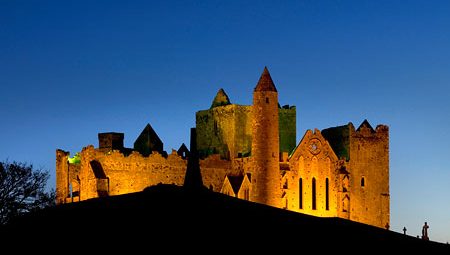
Bar. The Rock of Cashel is an imposing sight, once the seat of the Kings of
Munster, a symbol of royal and priestly power for more than a thousand years.
Adjoining the Rock of Cashel is the Bru Boru Cultural Centre.
Cobh. This was the calling point for many a famous ship – The Titanic
made her last stop here before heading to disaster. On the promenade stands
a monument to the victims of the Lusitania sunk in 1915. Midleton is a thriving
market town, Legend has it that it was here in Ireland that whiskey was invented.
In fact, the town boasts the largest pot still in the world. A stopover to
the Old Midleton Distillery is a must. This beautifully restored 18th Century
distillery is now a renowned tourist attraction and visitors have the opportunity
to become certified whiskey tasters! Midleton derives its name from 'Mainstir
na Corann' meaning 'The Abbey of the Choir'. This name came from a Cistercian
monastery, founded here in the 12th Century, but sadly, destroyed in the 19th
Century. St. John the Baptist Church is believed to be the site of the old
Abbey with records dating back to 1302.
Day 4
Cork - Blarney - Kinsale
Highlights
•
The Butter Exchange,
•
Cork City Hall
•
St. Ann’s Church, Shandon.
•
The English Market
•
Blarney Castle & Stone
•
Kinsale
•
Desmond Castle
•
Charles Fort
Cork City is over 800 years old and is built on an island in the River Lee
at the mouth of Cork Harbour. It is an important seaport and is not short of
Bridges and hilly streets. The city is dominated by St. Finbars Cathedral which
stands on the site of a monastery founded in the 7th century. It is an artistic
city, home to the Cork Opera House and many gallaries and theatres. The English
market (dating back to 1788), in the heart of the city is worth a visit and
a great chance to enjoy the ‘banter’ with the locals.
Blarney. The village of Blarney is just 8km (5miles) west of Cork City renowned
for its Castle, this historic Castle is famous for its stone which has the
traditional power of conferring eloquence on all who kiss it – and is
a must for those who dare!. Just across the village green is the Blarney Woollen
Mills store where you can purchase Irish Linens, Knitwear, Crystal and much
more.
Kinsale is less than a half hours drive from Cork City and is known as the
gourmet capital of Ireland. This traditional fishing port has retained its
old world charm and character but yet has a very cosmopolitan atmosphere. Its
waterside location has many features, including a yacht marina and many historic
buildings
Day 5
Cork - Killarney
Continuing west to the beautiful town of Killarney. On its doorstep are the
magnificent Lakes of Killarney, McGillycuddy Reeks and Carrantoohill, Ireland’s
highest mountain. Ross Castle (15th C) is a typical example of the stronghold
of an Irish Chieftain in the middle ages and has a beautiful position overlooking
Lough Leane.
Muckross House (19th C) is a magnificent Victorian mansion set in spectacular
surroundings and offers a glimpse into the life of the landed gentry.
•
Muckross House, Gardens & Farms
•
Ross Castle,
•
Killarney Lakelands
•
Coppermines
•
Traditional Music Pubs
Day 6
Killarney - Ring of Kerry - Killarney
Highlights
•
Cahergal Stone Forts
•
The Skelligs Experience
•
Valentia Island, Grotto
•
Glanleam Gardens
•
Staigue Fort
•
Derrynane House & Gardens
•
Sneem Sculpture Park
This enchanting 175km stretch of road on the Iveragh Peninsula rewards you
with some of the most breathtaking scenery the country has to offer. Its dramatic
coastline and picturesque villages, the views across Dingle Bay, the Skellig
Islands, the stunning vistas of Deenish and Scarriff Islands from the top of
Coomakista Pass are a sight to behold. Stop at Ringfort in Caherciveeen,
see where the Irish Liberator Daniel O’Connell was born, then onto Valentia
Island by ferry, view the Slate Quarry and Lighthouse before heading back to
the mainland. Drive the ‘hidden’ ring through the fishing village
of Portmagee, the remote St. Finians Bay, the gaelic speaking Baile na Scelig
and onto the seaside village of Waterville. Stop for a quick walk at Derrynane
Beach – visit its unique Graveyard before heading back to Killarney.
Wonderful views of Killarneys Lakeland and Torc Waterfall when you return via
Molls Gap
Day 7
Killarney - Adare - Limerick - Cliffs of
Moher
Highlights
•
Adare Heritage Centre
•
King John’s Castle 13th C
•
Cliffs of Moher
•
The Burren
•
Poulnabrone Dolmen 3000 BC
Adare is regarded as being Ireland's prettiest and most picturesque villages.
Situated on the river Maigue, a tributary of the river Shannon, Adare is steeped
in history dating back to 1200ad. Adare has been the subject of many rebellions,
wars and conquests, leaving behind a legacy of historical monuments. Adare's
streets are lined with original thatched cottages survived for hundreds of
years, which are a mix of restaurants and Arts & Craft shops. Before heading
for the cliffs of Moher you may like to visit King John’s Castle situated
on the River Shannon opens an exciting window on the lives and stories of the
people through political upheaval war and famine. Built in 1200 this is a most
impressive Anglo Norman fortification. Enjoy your last afternoon taking in
the Atlantic air on the rugged Cliffs of Moher, stretch your legs and walk
along the dramatic cliffs which rise nearly 700ft above the Atlantic.
A couple
of miles away, you'll find an amazing Karst limestone region called the
Burren,
which features caves, underground streams and rare alpine flora. The area also
has plenty of fascinating archaeological sites, including the 5000 year-old
Poulnabrone Dolmen. Option of staying in one of the little villages or returning
back nearer Shannon airport for your return flight, if you decide to head back
towards the airport you may like to stay in Bunratty and take in the traditional
Banquet at Bunratty Castle.
Day 8
Departure Day
Departure after a hot, cooked Irish breakfast.

Mountains

|